Wind Farm Cluster Tradeoffs
Exploring how neighboring wind farm configurations affect design tradeoffs through Monte Carlo sampling.
Key Question
How much regret can a wind farm developer face when neighboring farms are uncertain?
When designing a wind farm layout, developers must decide whether to: - Liberal strategy: Optimize assuming no neighbors will be built (maximize standalone performance) - Conservative strategy: Optimize assuming neighbors will appear (sacrifice standalone performance for robustness)
Regret measures the cost of choosing the wrong strategy.
Case Study: Danish Energy Island
We analyzed the real-world Danish Energy Island (DEI) cluster with 10 years of site wind data. Key finding: A single southern neighbor causes 101 GWh regret despite off-axis position.
| Neighbor Direction | Regret |
|---|---|
| Western (262°) - dominant wind | 0 GWh |
| Southern (163°) - secondary wind | 101 GWh |
| All 9 neighbors together | 101 GWh |
This demonstrates the "ambush effect": neighbors off-axis from the dominant wind can cause more regret than on-axis neighbors because the liberal layout doesn't account for them.
Main Findings
1. Sampled Regret Can Exceed 60 GWh/year
Among the randomly sampled blob configurations, the highest regret found was 61 GWh/year for a 16-turbine farm under single-direction wind conditions. This represents choosing the liberal strategy when neighbors appear.
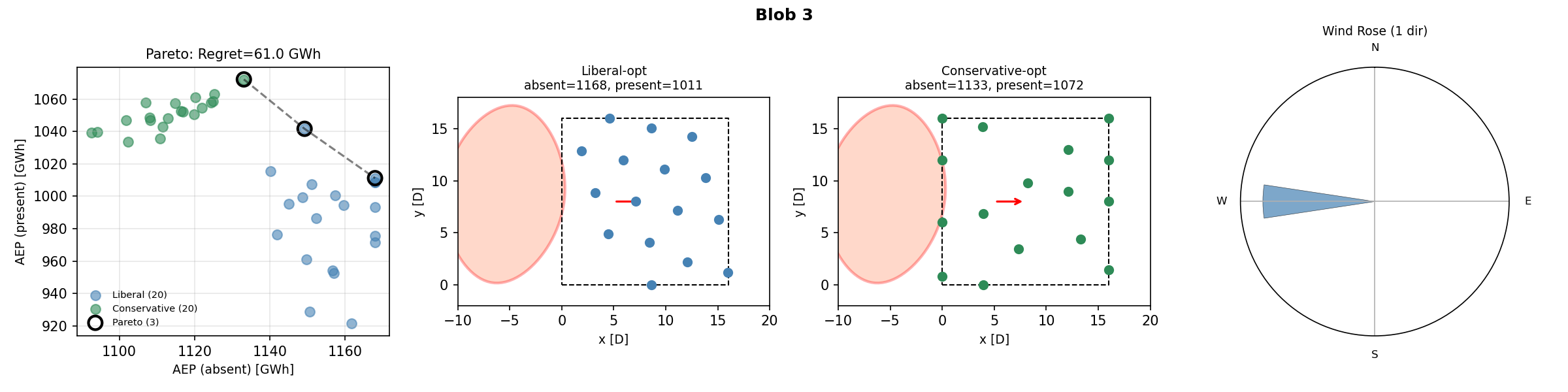 Blob 3 under single-direction wind (270°): The liberal-optimal layout achieves 1168 GWh alone but drops to 1011 GWh with neighbors. The conservative-optimal layout achieves 1133 GWh alone and 1072 GWh with neighbors. Regret = 61 GWh.
2. Wind Rose Type Dramatically Affects Regret
| Wind Rose | Max Regret (GWh) | Mean Regret (GWh) |
|---|---|---|
| Single (270°) | 60.99 | 20.2 |
| Von Mises κ=1 | 35.74 | 10.3 |
| Von Mises κ=4 | 31.76 | 13.9 |
| Uniform | 25.74 | 11.9 |
| Bimodal | 19.66 | 7.4 |
| Von Mises κ=2 | 16.13 | 4.4 |
3. Non-Monotonic Relationship with Directional Spread
Regret doesn't simply decrease with more wind directions. There's a sweet spot at moderate concentration (κ≈2):
Single → κ=1 → κ=4 → Uniform → Bimodal → κ=2
  61      36     32      26       20       16   (max regret, GWh)
Physical interpretation: - Too concentrated (single direction): Narrow but intense wake corridor creates sharp tradeoffs - Too diffuse (uniform): Neighbors affect you from all directions—no "safe" layout exists - Moderate (κ≈2): Directional preference allows layout adaptation without extreme penalties
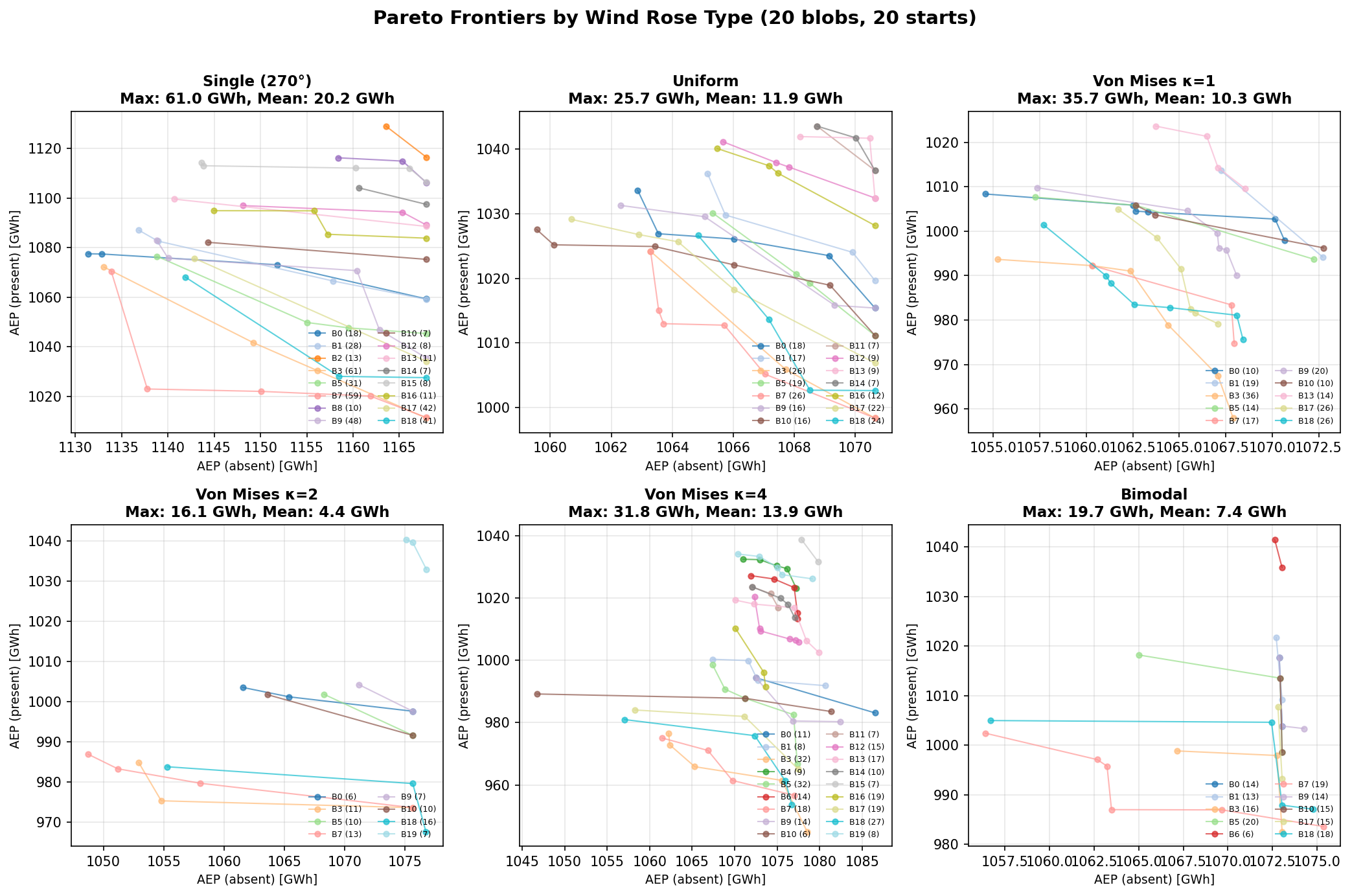 Pareto frontiers across wind rose types. Steeper, longer frontiers indicate higher regret.
Methodology
Random Blob Sampling + Pooled Multi-Start Optimization
We randomly sample 20 neighbor "blob" configurations per wind rose type. For each blob:
- Sample a random blob shape (B-spline with 4 control points)
- Run 20 multi-start SGD optimizations on target layout with liberal assumptions (ignoring neighbors)
- Run 20 multi-start SGD optimizations on target layout with conservative assumptions (accounting for neighbors)
- Pool all 40 target layouts
- Evaluate each layout under both scenarios
- Compute Pareto frontier and regret
Note: The blob shapes are randomly sampled, not optimized. This Monte Carlo approach explores the distribution of regret across neighbor geometries but does not find guaranteed worst-case configurations.
Regret Definition
- Pareto frontier: Layouts where no other layout dominates in both AEP_absent and AEP_present
- Liberal-optimal: Pareto point maximizing AEP when neighbors are absent
- Conservative-optimal: Pareto point maximizing AEP when neighbors are present
- Regret = AEP_present(conservative) − AEP_present(liberal)
Convergence Verification
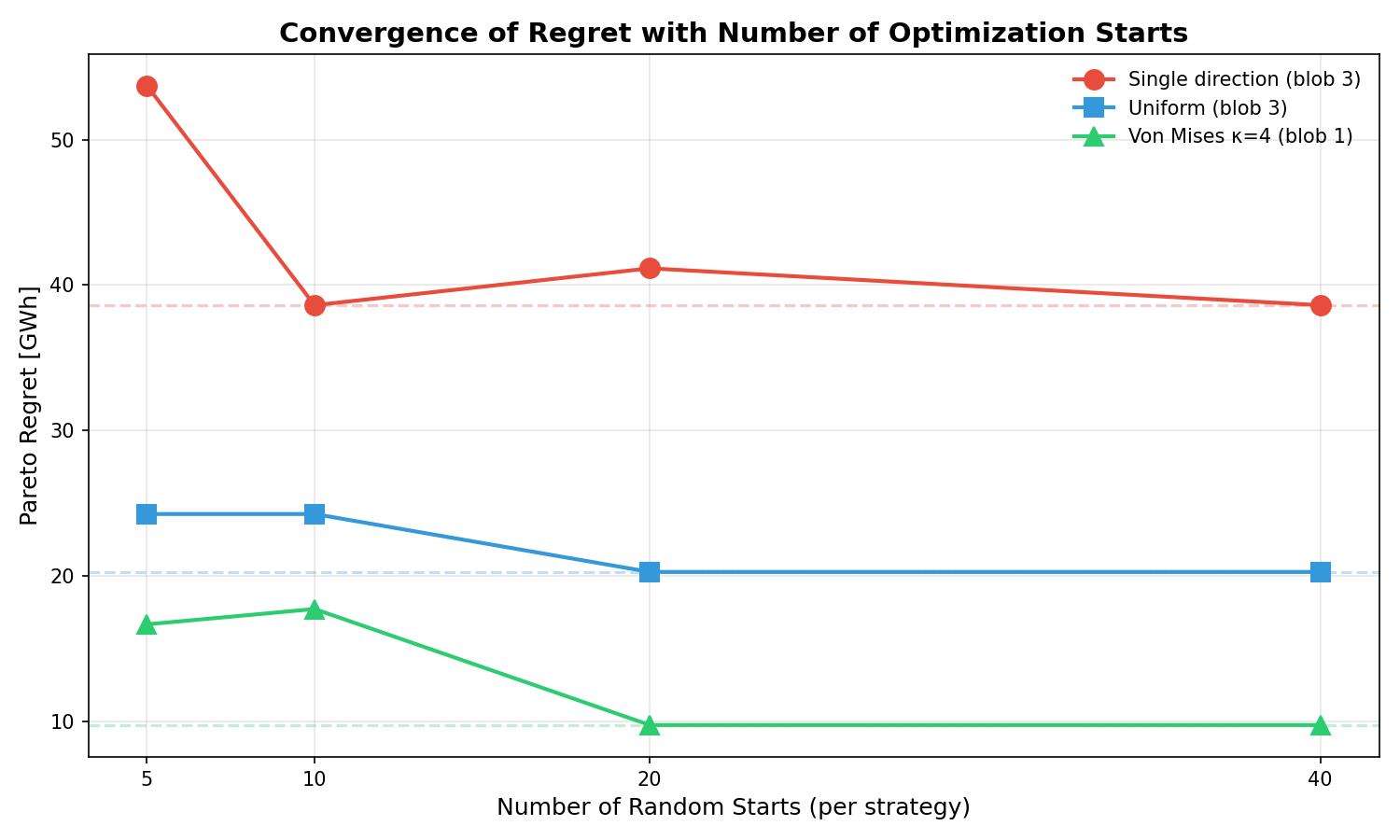
Regret values stabilize by n=20 starts per strategy:
| Configuration | n=5 | n=10 | n=20 | n=40 |
|---|---|---|---|---|
| Single direction | 53.70 | 38.62 | 41.15 | 38.62 |
| Uniform | 24.27 | 24.27 | 20.29 | 20.29 |
| Von Mises κ=4 | 16.69 | 17.75 | 9.77 | 9.77 |
Setup
Configuration
- Target farm: 16 turbines in 16D × 16D area (D = 200m rotor diameter)
- Minimum spacing: 4D between turbines
- Neighbor representation: Randomly sampled "blob" shapes using B-spline boundaries (20 samples per wind rose type)
- Neighbor grid: 25 potential turbine positions on a 5×5 grid, masked by blob boundary
- Wake model: Bastankhah Gaussian deficit (k=0.04)
- Turbine: 10 MW class (200m rotor, 120m hub height)
Wind Rose Types
| Type | Description |
|---|---|
| Single | Unidirectional, 270° (West) |
| Uniform | 24 directions, equal probability |
| Von Mises | Circular normal distribution centered at 270° |
| Bimodal | Two peaks at 270° (70%) and 90° (30%) |
The Von Mises concentration parameter κ controls spread: - κ = 0: Uniform - κ = 2: Moderate (typical offshore) - κ → ∞: Single direction
Replication
Prerequisites
git clone https://github.com/kilojoules/cluster-tradeoffs.git
cd cluster-tradeoffs
pixi install
Run Full Analysis
# Full wind rose comparison (20 blobs × 20 starts × 6 types ≈ 4-6 hours)
pixi run python scripts/run_regret_discovery.py \
    --wind-rose=comparison \
    --n-blobs=20 \
    --n-starts=20

# Single wind rose type
pixi run python scripts/run_regret_discovery.py \
    --wind-rose=von_mises \
    --concentration=2.0 \
    --n-blobs=10 \
    --n-starts=20

# Convergence study
pixi run python scripts/run_convergence_study.py
Command-Line Options
--wind-rose, -w     Type: single, uniform, von_mises, bimodal, comparison
--n-directions, -d  Number of wind directions (default: 24)
--dominant-dir      Dominant direction in degrees (default: 270)
--concentration, -k Von Mises kappa parameter (default: 2.0)
--n-blobs           Number of blob configurations (default: 10)
--n-starts          Optimization starts per strategy (default: 10)
--output-dir, -o    Output directory
Results by Wind Rose Type
Detailed analysis for each wind rose configuration:
- Single Direction (270°)
- Von Mises κ=1 (Broad Spread)
- Von Mises κ=2 (Optimal)
- Von Mises κ=4 (Concentrated)
- Uniform Distribution
- Bimodal Distribution
Real-World Case Study
- Danish Energy Island (DEI) - Analysis with Bastankhah and OMAE wake models
- DEI: Nygaard 2022 Wake Model - Analysis with PyWake literature defaults
Wake Model Sensitivity (A Parameter Sweep)
- DEI: A=0.02 (Narrow Wakes) - Higher regret with concentrated wake effects
- DEI: A=0.10 (Wider Wakes) - Lower regret with dissipating wakes
References
- Wake model: Bastankhah & Porté-Agel (2014)
- Optimization: JAX-based gradient descent with soft boundary constraints
- Wind rose statistics: Von Mises distribution for circular data
Generated with pixwake - JAX-based wind farm simulation