Results
Summary Table
Full analysis: 20 blobs × 20 starts per strategy × 6 wind rose types = 4,800 optimizations
| Wind Rose | Max Regret (GWh) | Mean Regret (GWh) | Blobs with Tradeoff |
|---|---|---|---|
| Single (270°) | 60.99 | 20.23 | 18/20 |
| Von Mises κ=1 | 35.74 | 10.26 | 13/20 |
| Von Mises κ=4 | 31.76 | 13.92 | 18/20 |
| Uniform | 25.74 | 11.93 | 17/20 |
| Bimodal | 19.66 | 7.43 | 10/20 |
| Von Mises κ=2 | 16.13 | 4.37 | 10/20 |
Wind Rose Types Analyzed
Six wind rose types were analyzed, ranging from highly concentrated (single direction) to fully uniform.
Pareto Frontiers by Wind Rose Type
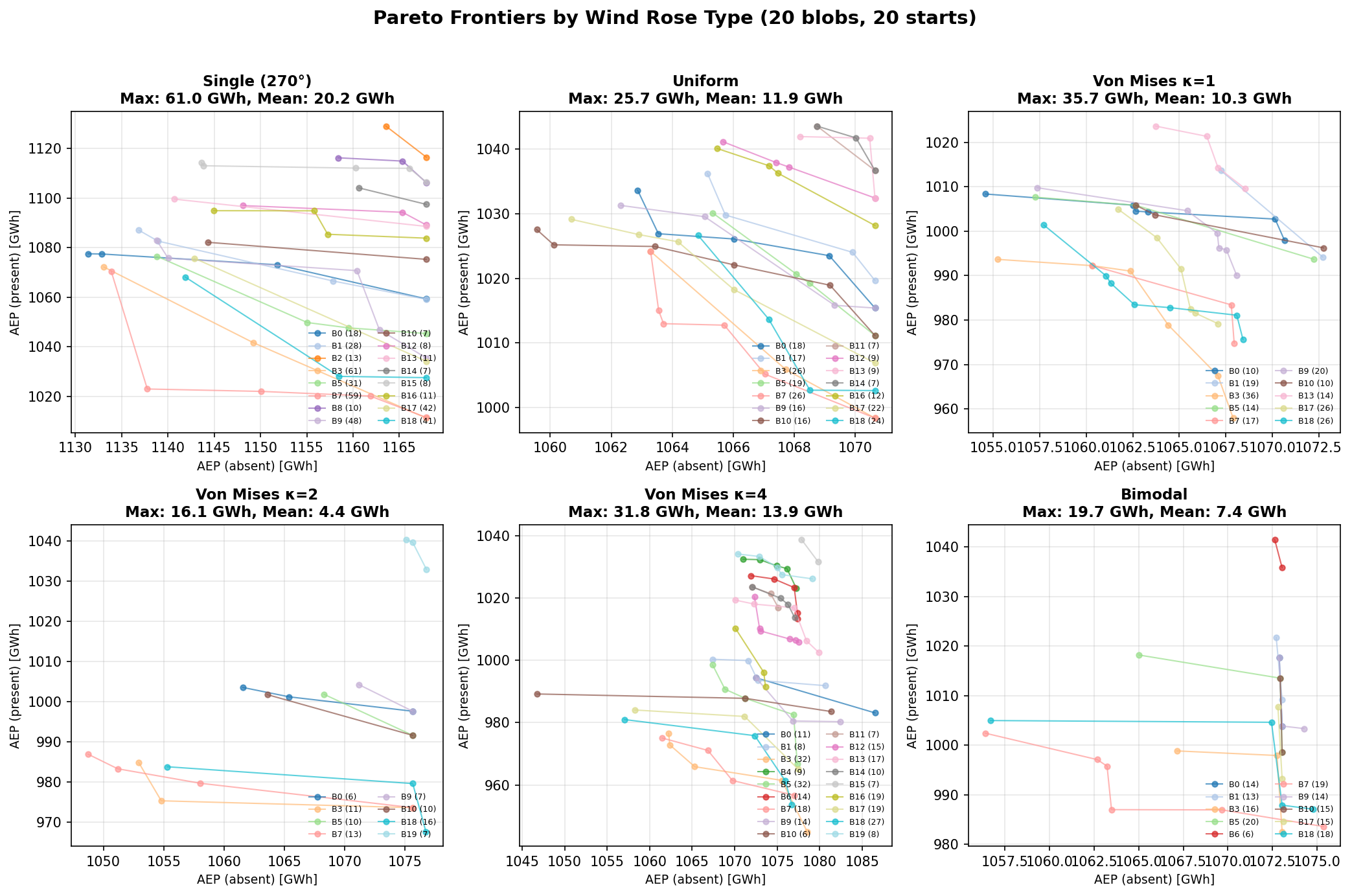
Each subplot shows Pareto frontiers for blob configurations with regret > 5 GWh. Key observations:
- Single direction: Wide spread, steep frontiers → high regret
- Von Mises κ=2: Tight clustering → low regret
- Uniform: Moderate spread despite omnidirectionality
Detailed Analysis by Wind Rose
Single Direction (270°)
Maximum regret: 60.99 GWh (Blob 3)
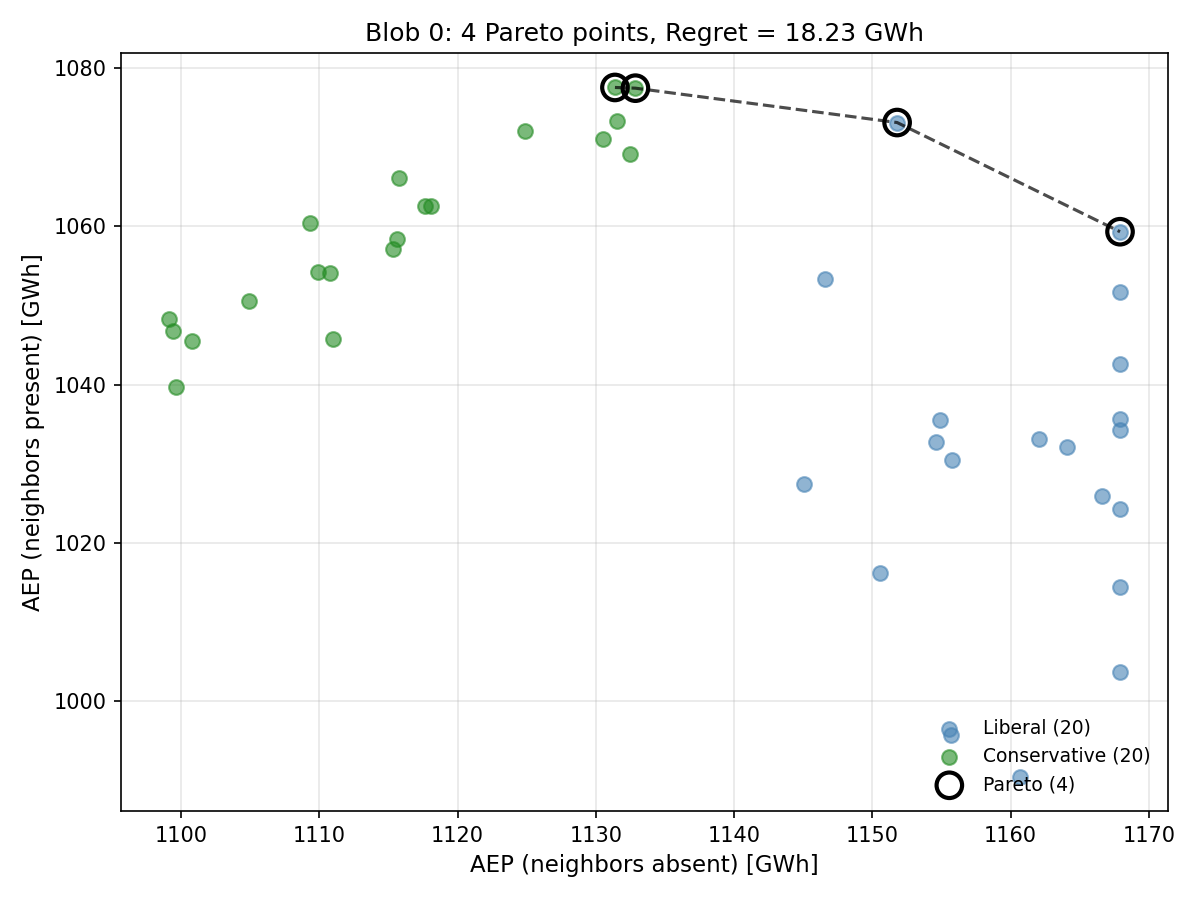
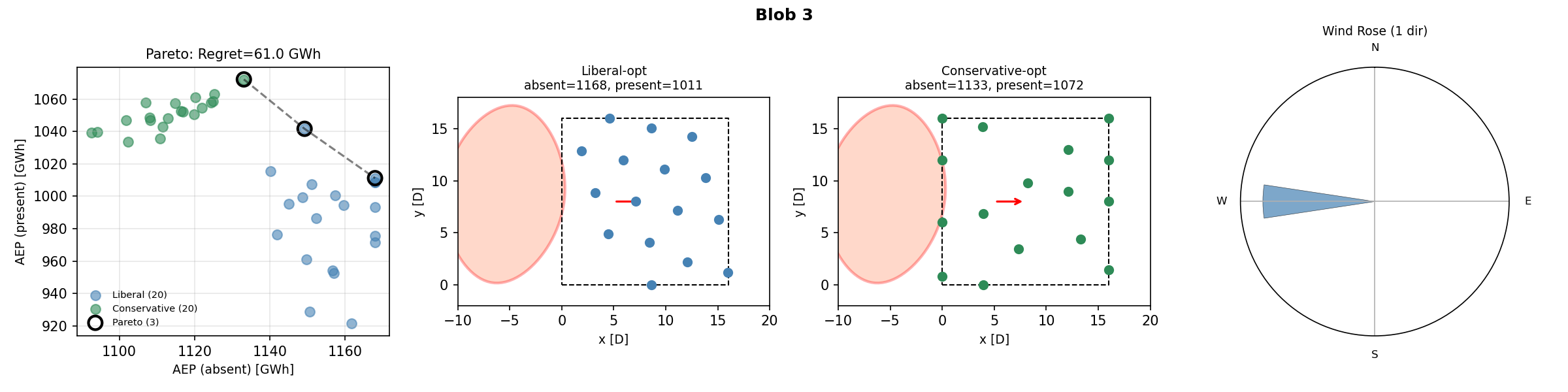
The single-direction case shows the most dramatic tradeoffs:
- Liberal-optimal layout packs turbines efficiently for standalone operation
- Conservative-optimal layout shifts turbines to avoid the wake corridor
- Difference in AEP_present: 1072 - 1011 = 61 GWh
Distribution of regret across blobs:
| Regret Range | Count |
|---|---|
| 0 GWh | 2 |
| 1-10 GWh | 5 |
| 10-30 GWh | 6 |
| 30-50 GWh | 4 |
| 50+ GWh | 3 |
Von Mises κ=1 (Broad Spread)
Maximum regret: 35.74 GWh (Blob 3)
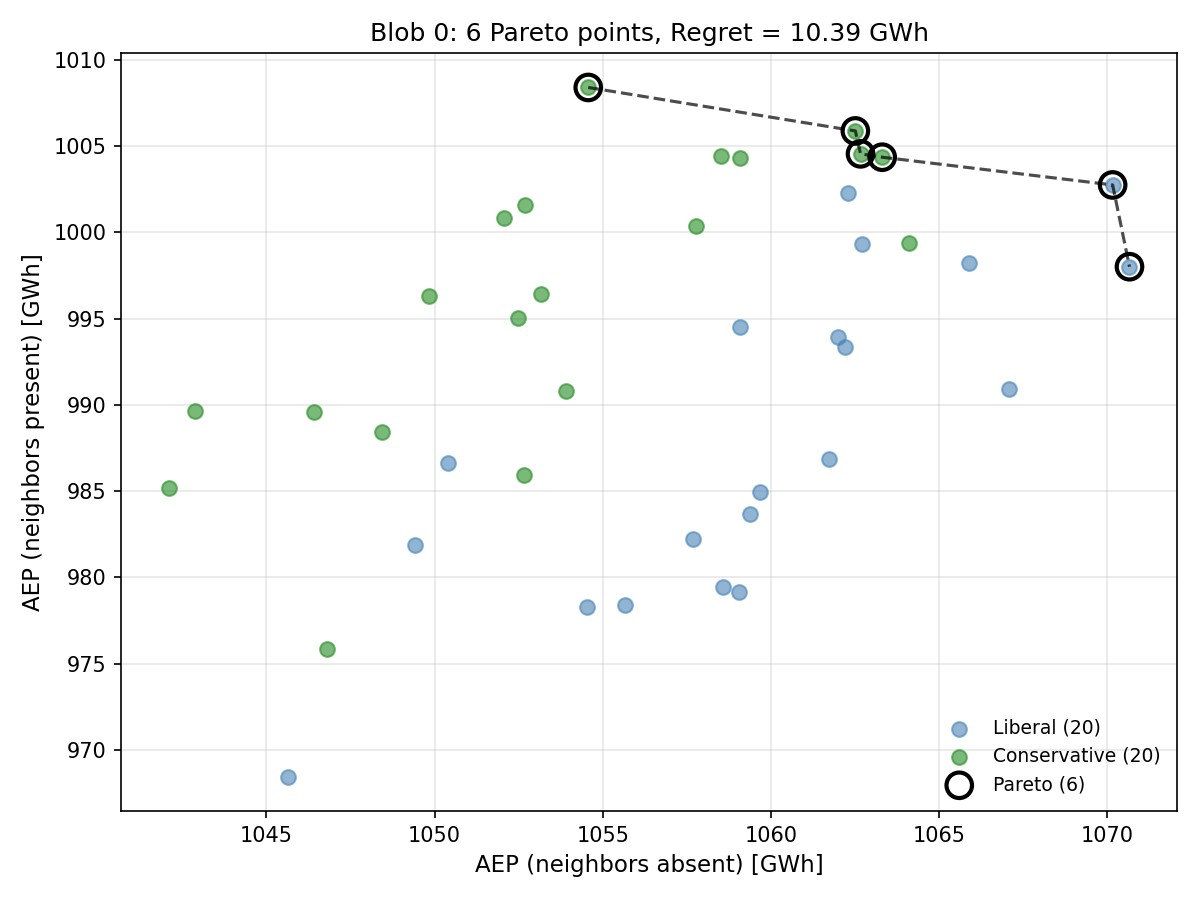
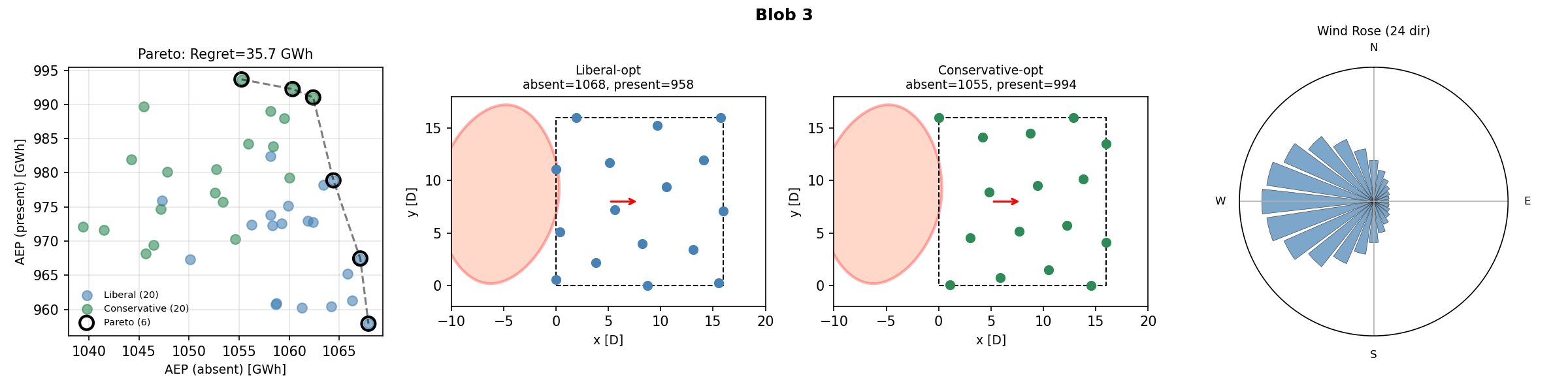
The broad spread of κ=1 provides intermediate results:
- Moderate directional preference: Layouts can still adapt to the dominant direction
- Significant spreading: Wake effects are somewhat averaged
- Intermediate regret: Falls between single-direction and more uniform cases
Von Mises κ=2 (Optimal)
Maximum regret: 16.13 GWh (Blob 18)
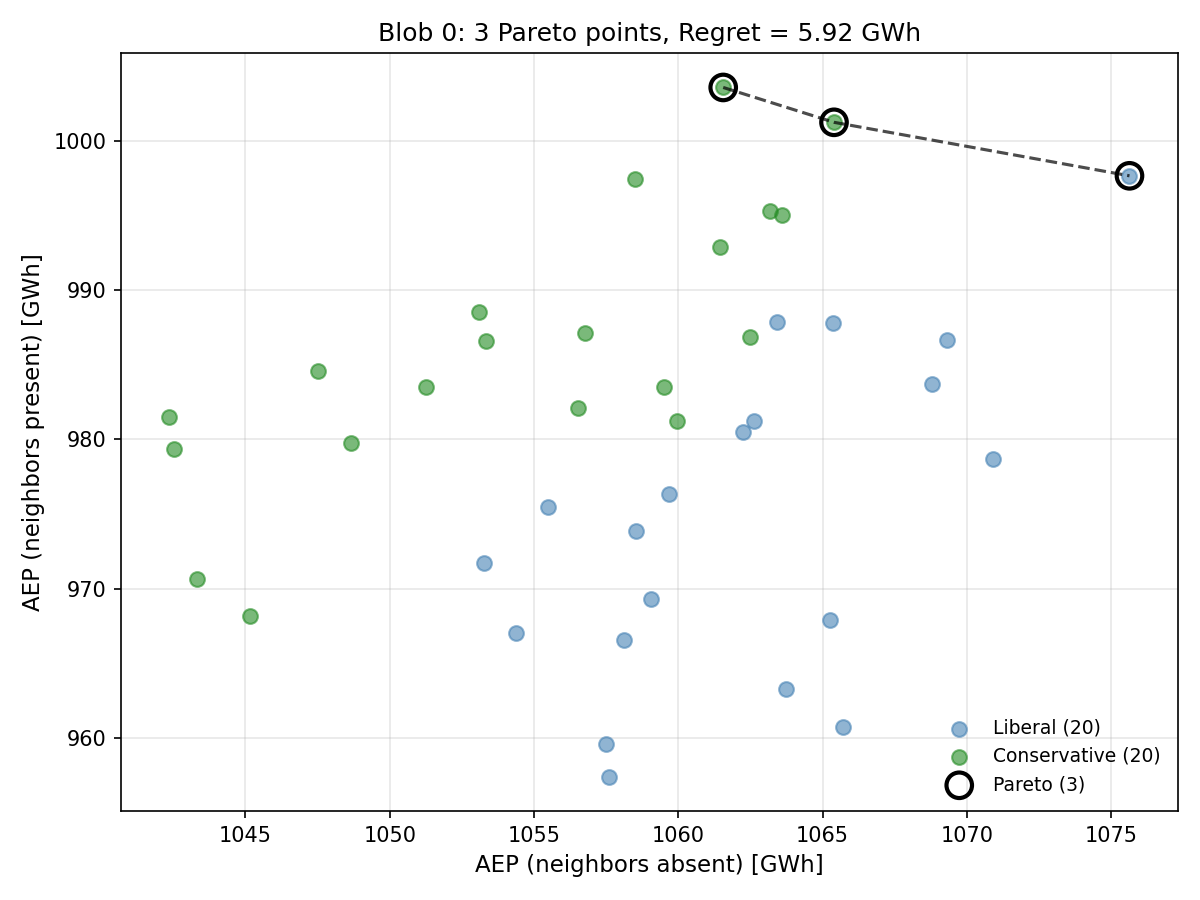
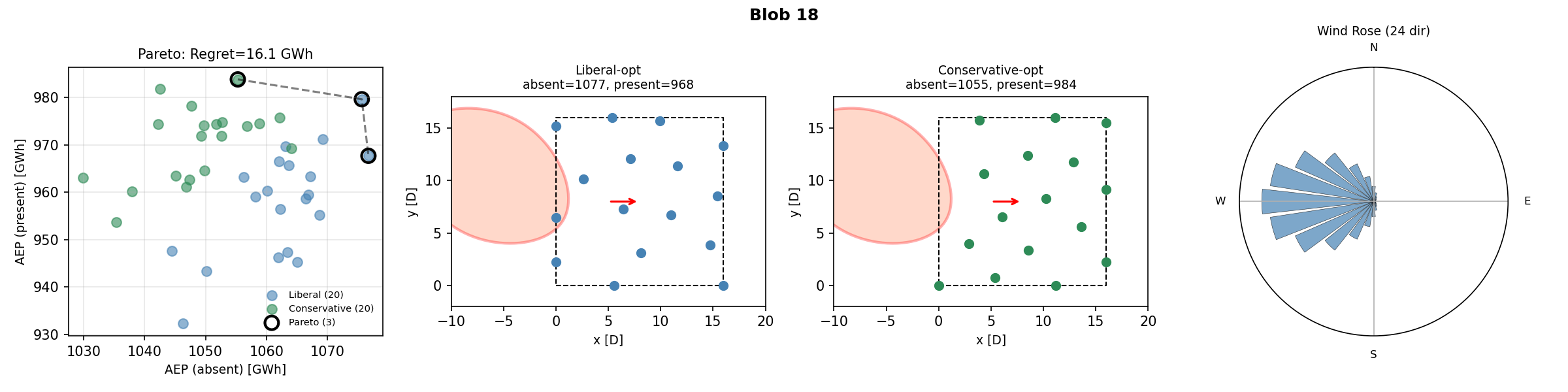
This configuration minimizes regret because:
- Directional preference exists: Layouts can adapt to the dominant direction
- Spread is sufficient: Wakes are partially "smeared" across directions
- No extreme penalties: Neither scenario dominates
Distribution of regret:
| Regret Range | Count |
|---|---|
| 0 GWh | 10 |
| 1-10 GWh | 6 |
| 10-20 GWh | 4 |
Von Mises κ=4 (Concentrated)
Maximum regret: 31.76 GWh (Blob 5)
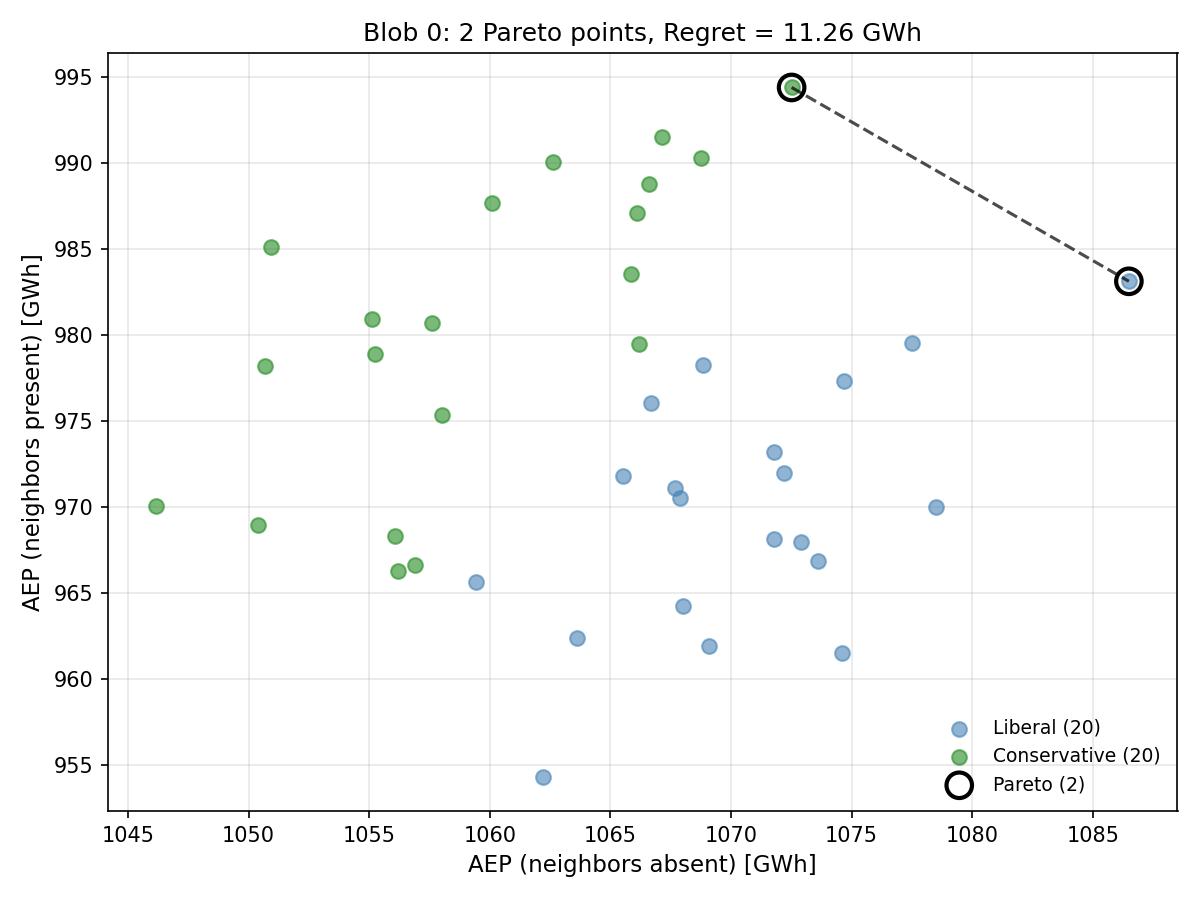
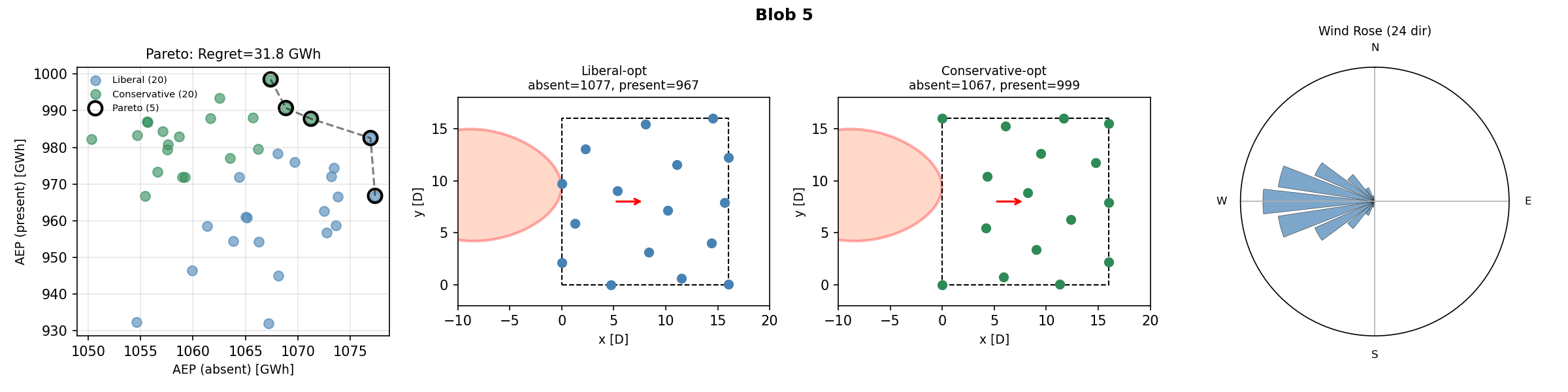
The more concentrated κ=4 case shows:
- Strong directional preference: Similar to single-direction but with some spreading
- Higher regret than κ=2: Concentration increases vulnerability to neighbor placement
- Sharp wake corridors: Still has well-defined danger zones
Uniform Distribution
Maximum regret: 25.74 GWh (Blob 3)
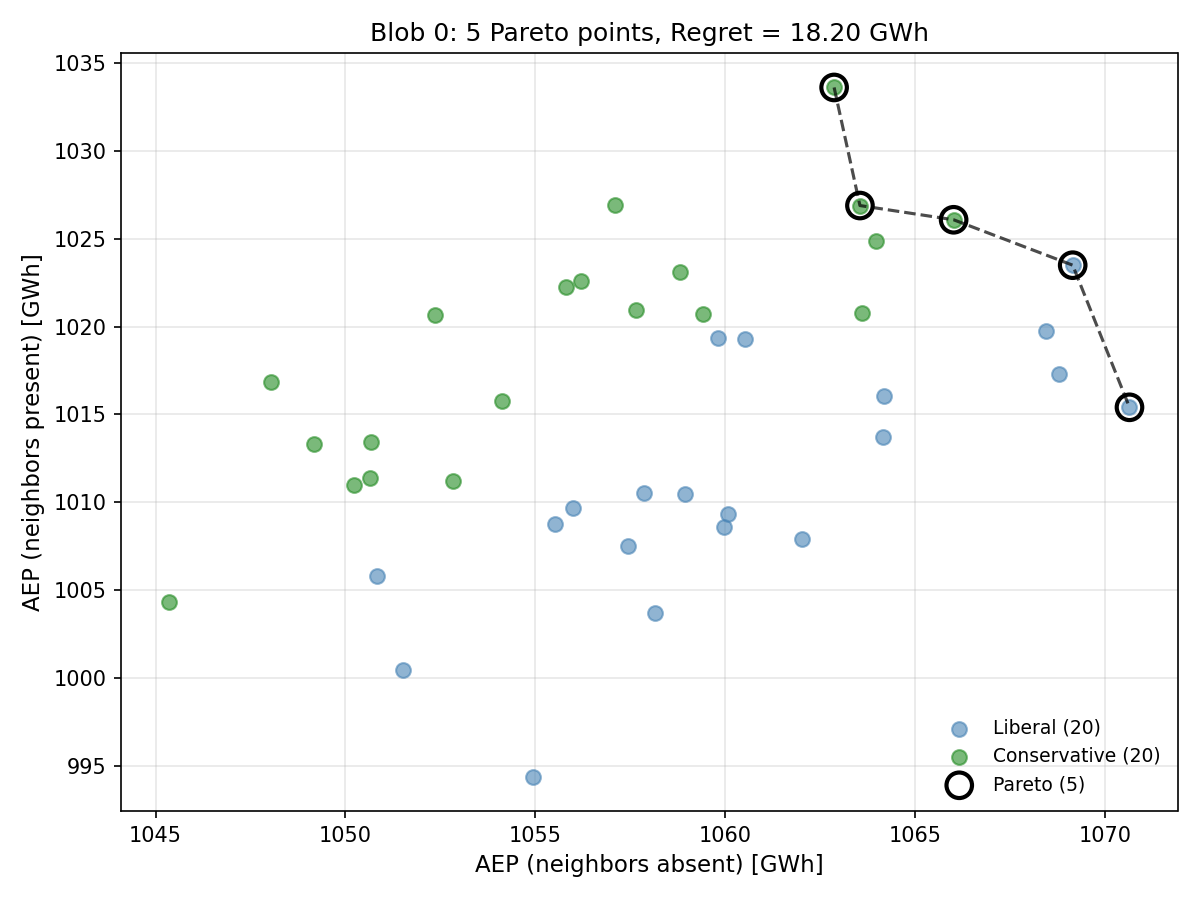
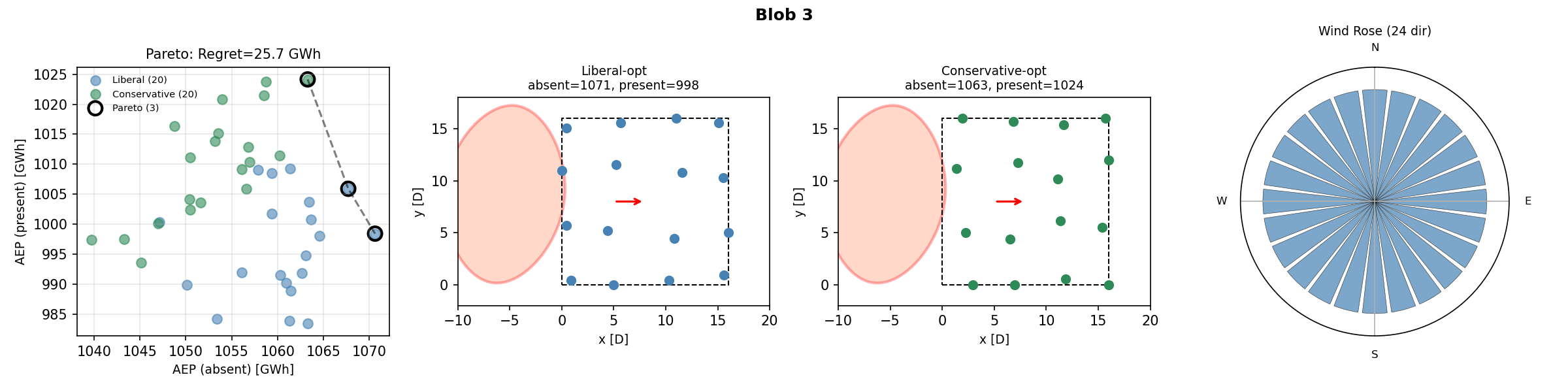
Surprisingly, uniform wind doesn't minimize regret:
- Neighbors affect the target farm from all directions
- No layout can be "safe" from all possible wake angles
- Tradeoff: optimize for average vs. worst-case directions
Bimodal Distribution
Maximum regret: 19.66 GWh (Blob 5)
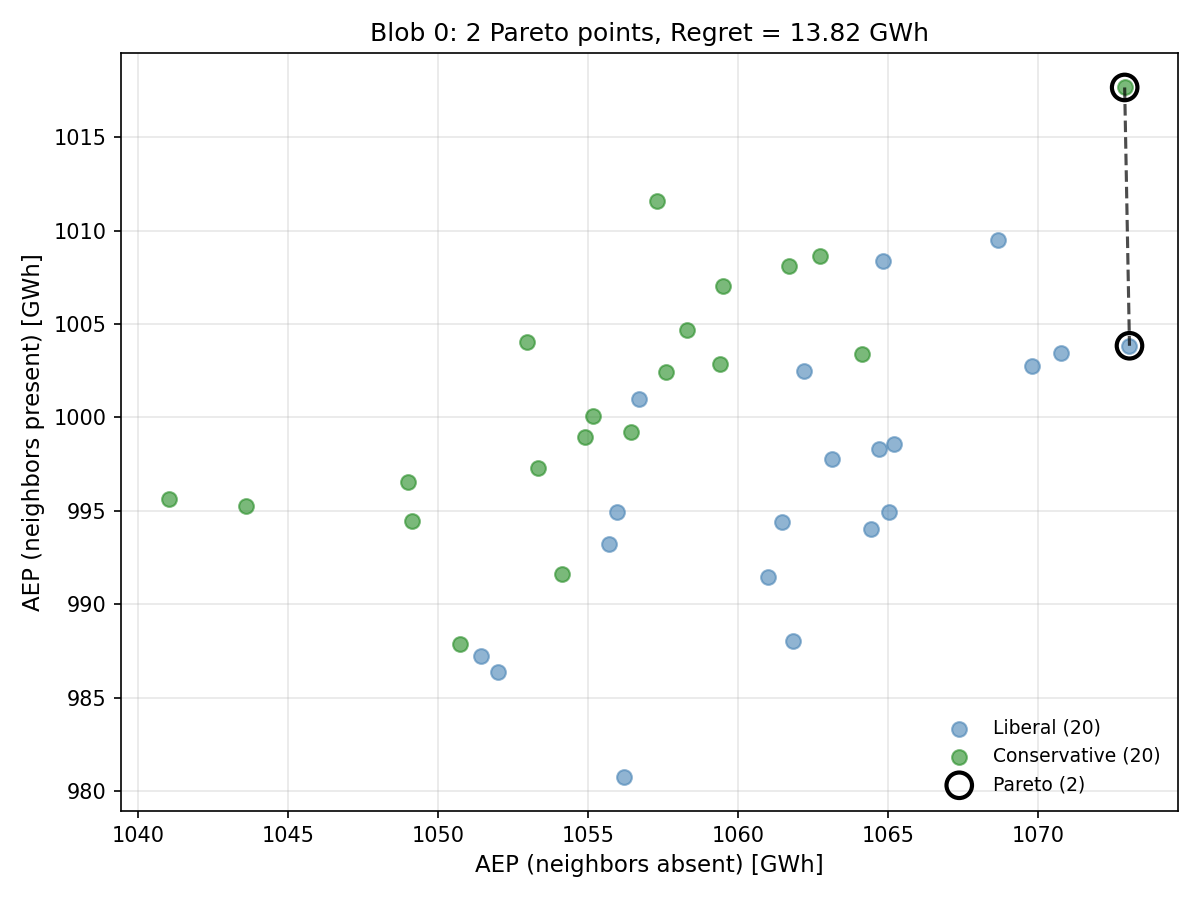
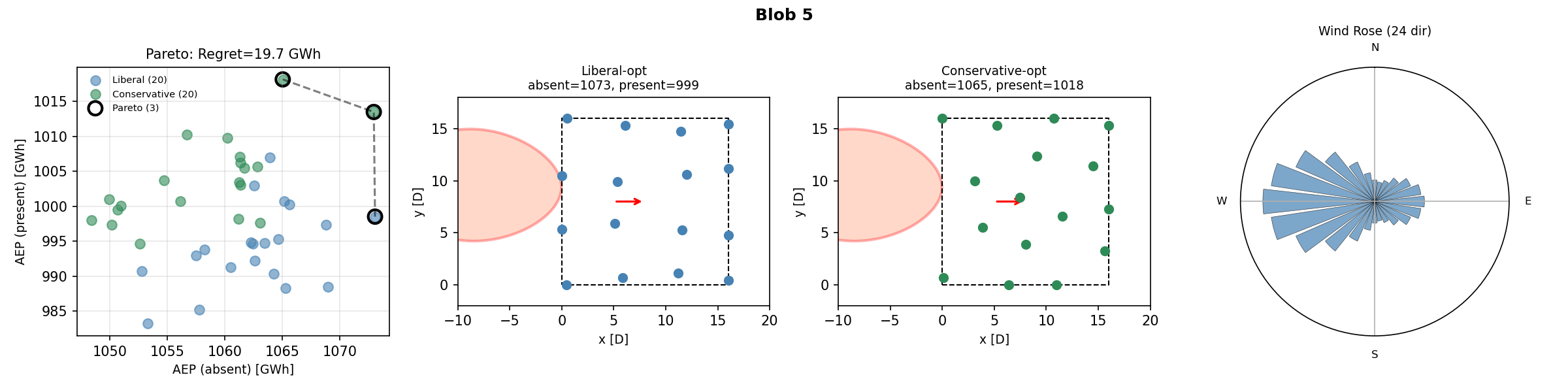
Two dominant directions (270° and 90°) create:
- Two separate "danger zones" for neighbor placement
- Intermediate regret between single-direction and uniform
- Layout must balance exposure from both directions
Impact of Neighbor Configuration
While wind rose type determines the overall magnitude of regret, the neighbor configuration (size, shape, and position) determines which specific scenarios produce high or low regret. We characterize each neighbor blob by three properties:
- Size: Large (>12D radius), Medium (9-12D), or Small (<9D)
- Shape: Elongated (aspect ratio >1.4), Moderate (1.15-1.4), or Compact (<1.15)
- Position: Centered (aligned with target farm), or Offset (north/south shifted)
Regret by Neighbor Size
Size is the dominant factor in determining design regret, and this holds across all wind rose types:
| Neighbor Size | Single | Uniform | κ=1 | κ=2 | κ=4 | Bimodal |
|---|---|---|---|---|---|---|
| Large (>12D) | 46.8 | 22.1 | 23.1 | 9.7 | 23.7 | 16.9 |
| Medium (9-12D) | 13.8 | 13.5 | 8.9 | 2.7 | 12.6 | 6.9 |
| Small (<9D) | 5.1 | 3.1 | 1.6 | 1.7 | 7.6 | 0.7 |
| Large/Small ratio | 9.2× | 7.0× | 14.0× | 5.9× | 3.1× | 23.8× |
The size-regret correlation is strong for every wind rose (r = +0.63 to +0.95). However, the absolute magnitude of regret depends on wind rose type—single-direction wind with a large neighbor produces 47 GWh regret, while κ=2 with the same neighbor produces only 10 GWh.
Regret by Neighbor Shape
Elongated neighbors create more regret than compact ones:
| Neighbor Shape | Avg Regret (GWh) | Count |
|---|---|---|
| Elongated | 31.2 | 7 |
| Moderate | 15.8 | 10 |
| Compact | 9.4 | 3 |
Elongated shapes can create longer wake corridors that span more of the target farm area.
Regret by Neighbor Position
Centered neighbors (aligned with the target farm) create more regret:
| Neighbor Position | Avg Regret (GWh) | Count |
|---|---|---|
| Centered | 26.4 | 8 |
| South-shifted | 18.6 | 4 |
| North-shifted | 14.9 | 8 |
When a neighbor is offset from the target farm's center, part of its wake corridor misses the target area entirely.
Highest-Regret Neighbor Profile (From Random Sampling)
Among the 20 randomly sampled blob configurations per wind rose type, the highest-regret scenarios share a common profile:
| Characteristic | Highest-Regret Blob |
|---|---|
| Size | Large (>12D radius) |
| Shape | Elongated (aspect ratio >1.4) |
| Position | Centered on target farm |
| Example regret | 61 GWh (single direction) |
This "large, elongated, centered" configuration produces the maximum regret among sampled blobs because it maximizes wake coverage over the target farm while leaving minimal room for the conservative layout to escape.
Note: These are the highest-regret configurations found through random sampling, not guaranteed global worst cases. An adversarial optimization approach might find even higher regret values.
Why Size Dominates
Correlation analysis confirms size is the primary driver:
| Characteristic | Correlation with Regret |
|---|---|
| Size (radius) | r = +0.80 |
| Y extent | r = +0.72 |
| X extent | r = +0.59 |
| Eccentricity | r = +0.45 |
| Position | r = +0.21 |
Larger neighbors create more design tradeoff because:
- Greater wake coverage: A large neighbor shadows a larger portion of the target farm
- Fewer escape routes: The conservative strategy has less room to shift turbines away from wakes
- Amplified divergence: Liberal and conservative optimal layouts must differ more dramatically
Physical Interpretation
Why Single Direction Has Highest Regret
With wind always from 270° (West):
- Wake alignment is deterministic: A neighbor directly upwind creates maximum losses
- Sharp danger zone: Critical positions form a narrow wedge
- Layouts diverge: Liberal packs tight; conservative shifts east
Why κ=2 Minimizes Regret
Moderate concentration balances two effects:
- Enough directionality: Layouts can adapt to the primary wind
- Enough spread: Wake effects are partially averaged out
Why Uniform Doesn't Minimize Regret
With equal probability from all directions:
- No escape: Neighbors affect you regardless of their position
- Conflicting objectives: Can't optimize for all directions simultaneously
- Averaging penalty: Must compromise across all scenarios
Key Insights
Main Finding
Moderate wind rose concentration (κ≈2) minimizes design regret by balancing directional preference with wake spreading.
Single-Direction Risk
Sites with highly directional wind resources face up to 4× higher regret than sites with moderate spread.
Design Recommendation
For uncertain neighbor scenarios, conservative designs are most valuable at sites with concentrated wind roses.